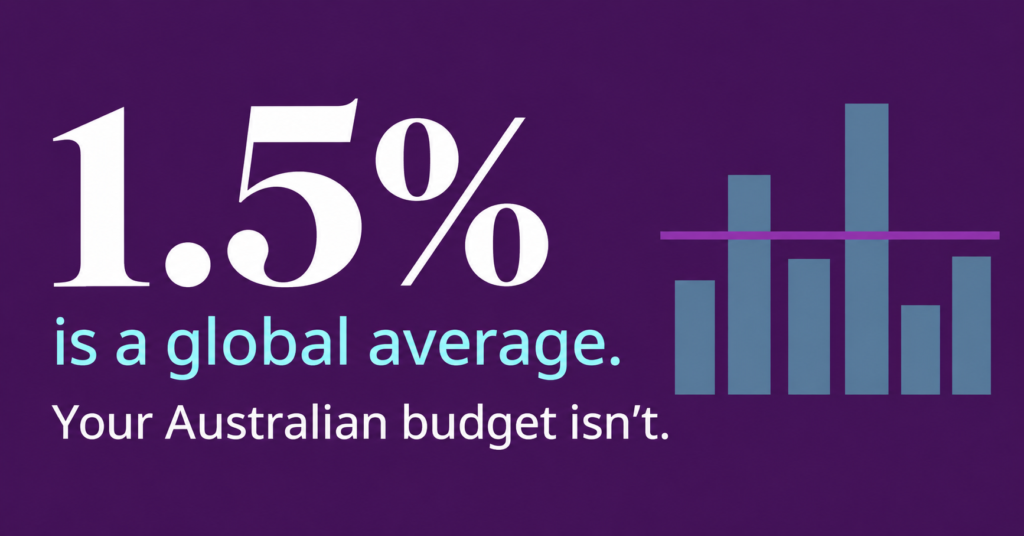
It is also a global average. The forecast’s own authors advise travel buyers to evaluate costs by region, market and category rather than rely on global averages.
For US-headquartered organisations running Australian events from a central team, that advice matters more than usual in 2027. BCD Meetings & Events expects North American budgets to stay broadly flat, with greater financial discipline and continued agency consolidation. Centralising event sourcing is a rational response to that pressure. The real question is what it costs in a market on the other side of the Pacific.
Here is the short answer. Sourced from offshore without local relationships, Australian events often land well above that benchmark, because the rates, terms and availability that keep costs down go to the buyers suppliers already know.
A global average is not an Australian budget
The categories driving event inflation are the most local ones. GBTA names food and beverage and production as the primary drivers of meeting cost inflation, and both are priced venue by venue and supplier by supplier. Hotel rates show the same spread: GBTA forecast 2026 rate growth of 5% in APAC, against 3.2% in North America and 0.6% in EMEA.
BCD expects costs and conditions across APAC to vary widely in 2027, from premium, established hubs like Singapore to cheaper, fast-growing markets in India, China and Southeast Asia.”
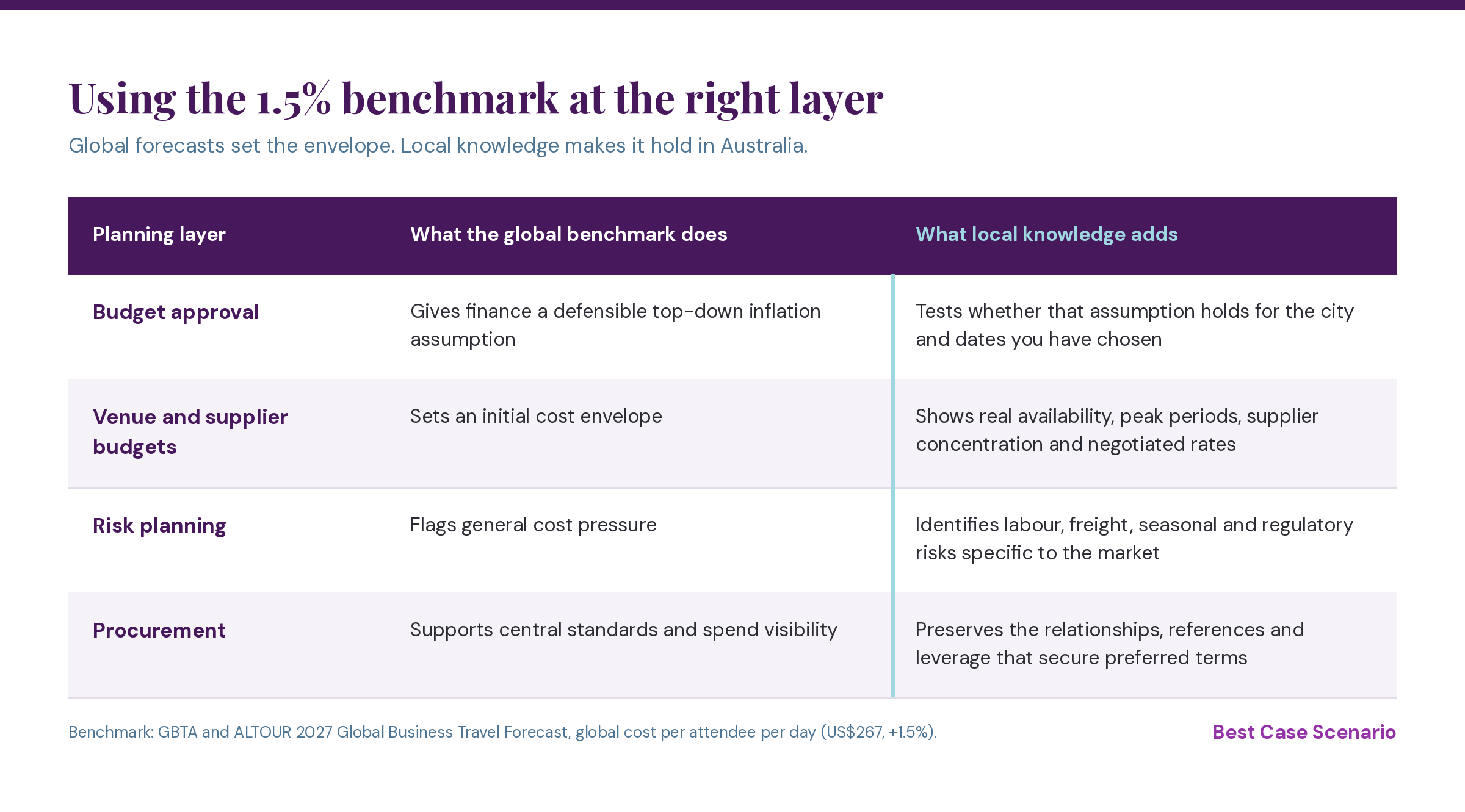
So the 1.5% figure is useful, but only at the right layer.
Negotiating power is where the money is
Without local relationships, you will usually pay more in Australia. Suppliers here keep their best rates, most flexible terms and first call on availability for the buyers they work with year after year. A booking from an offshore team, however large the parent company, starts at the rate card.
A local event partner brings that standing to your event. Repeat business across many programs gives them leverage that a single brand running a handful of Australian events a year rarely has. It also gives them the credibility to push back on a quote, hold a date or renegotiate terms when plans change.
What centralised sourcing quietly gives up
Central control brings real benefits: consistent brand standards, spend visibility and cleaner supplier management. The risk is losing the local relationships that protect a budget when conditions shift. Beyond price, those relationships provide four more things a global rate card cannot.
- Early sight of rate movements. Suppliers tell regular partners about availability and pricing changes before they reach a rate card.
- Knowing when not to buy. Peak-period compression, inflexible cancellation terms and clashes with major events are far easier to avoid than to fix.
- Visibility of hidden costs. A cheaper quote can carry freight, rework, weekend and public holiday labour loadings, or compliance requirements that only appear on the final invoice.
- Same-day problem solving. A supplier issue at 9am in Sydney lands at the end of the US working day, or after it. Someone needs to be on the ground with the authority and relationships to fix it.
Local expertise is a governance layer, not a cost line
A local partner does more than lower your costs. It is the control layer that makes a global event strategy executable in Australia. That speaks directly to what US stakeholders are measured on: budget discipline, risk management, compliance, brand consistency and demonstrable return.
BCD’s 2027 outlook points the same way, expecting outsourcing of selected planning functions and demand for flexible external expertise to shape North American sourcing. The model that works is global standards set at head office, with local execution and market intelligence underneath.
To make that case internally, track a short set of measures across your APAC program:
- Budget variance: approved against final cost, by market and category.
- Rate protection: share of venues, hotels, AV and production secured at preferred or contracted rates.
- Change orders: late changes, supplier substitutions and rush fees.
- Risks flagged before commitment: availability, compression, seasonal pricing and regulatory changes identified early.
- Total cost of ownership: organiser fees plus rework, freight, currency exposure and on-site issue resolution.
That turns local knowledge from a relationship argument into a measurable cost-control capability.
How BCS works with US-headquartered teams
Best Case Scenario is a Sydney-based event management and production agency that works inside global frameworks, not around them. Our team includes Gartner’s former Director of Events, Marketing Director of Events and Operations Director for Symposium/Xpo, so we know how a US head office briefs, approves and reports on regional events.
Working with US teams is our normal, not an adjustment. We are used to briefs that land overnight, approval chains that sit in another time zone, and brand, procurement and reporting standards set by head office. We work to those standards from day one, so your team gets local delivery without having to translate it back for HQ.
That experience sits alongside nearly two decades of repeat business with Sydney venues, AV and production suppliers. It gives our clients preferred rates, priority access and room to renegotiate when plans shift: standing that a global team booking from offshore cannot build on its own.
You set the standards and own the audience. We handle the operations, the suppliers and the local market intelligence that keeps your budget where you approved it.
Get a second opinion on your 2027 Australian event plan. Before you lock in dates and rates, we will review your calendar against local venue and supplier conditions, and pressure-test your budget assumptions for the Australian market.